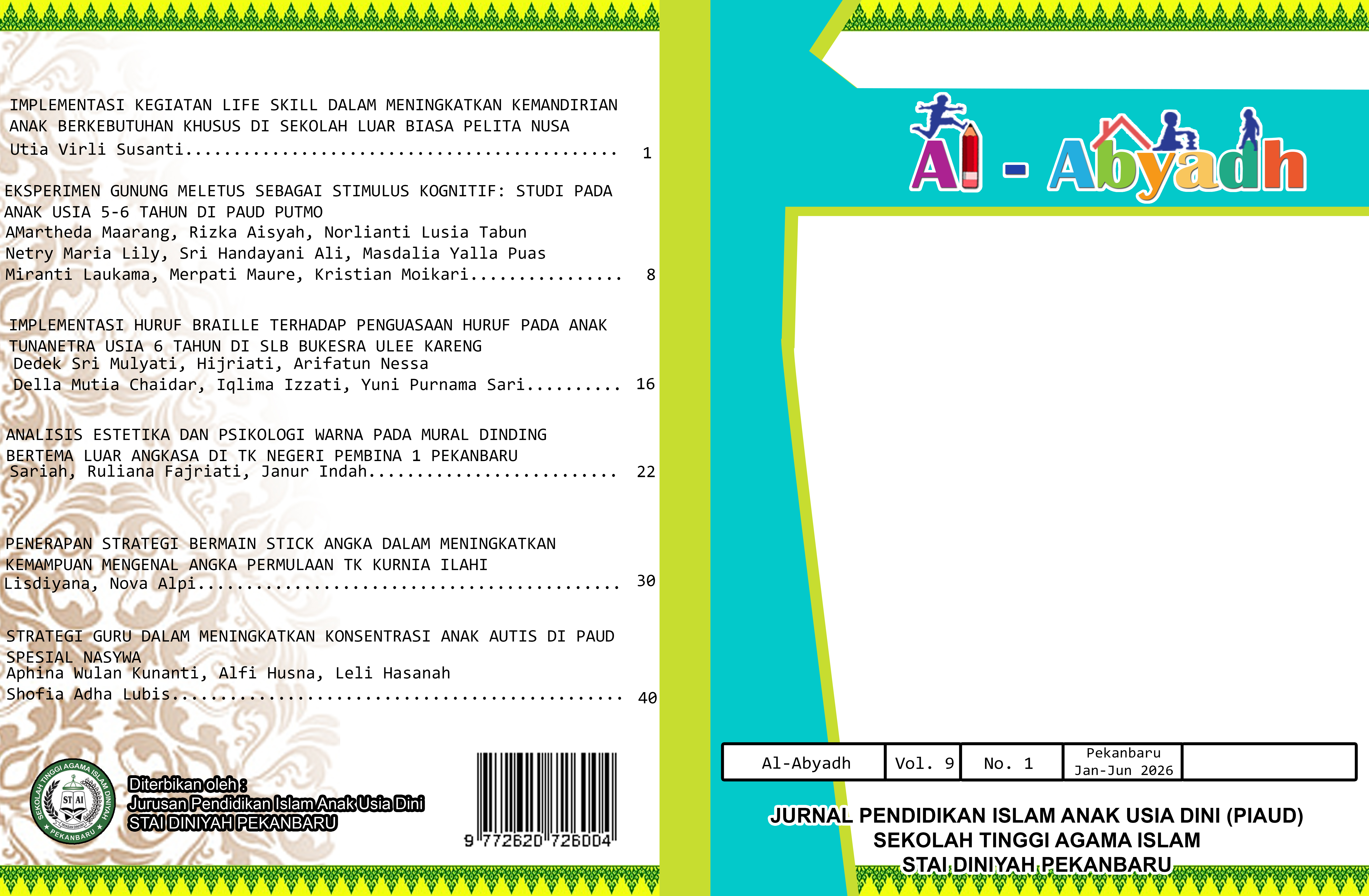
STRATEGI GURU DALAM MENINGKATKAN KONSENTRASI ANAK AUTIS DI PAUD SPESIAL NASYWA
DOI:
https://doi.org/10.46781/al-abyadh.v9i1.2307Keywords:
Strategi Guru, Konsentrasi, Anak AutisAbstract
Penelitian dilakukan untuk mengkaji dan menggambarkan strategi yang diterapkan guru dalam upaya meningkatkan kemampuan konsentrasi anak dengan autisme di PAUD Spesial Nasywa Banda Aceh. Pendekatan kualitatif deskriptif dengan metode studi kasus digunakan untuk memperoleh pemahaman yang mendalam mengenai fenomena yang diteliti. Subjek penelitian dua guru pendamping khusus serta tiga anak dengan autisme berusia 4–6 tahun yang menunjukkan tingkat konsentrasi relatif rendah. Pengumpulan data melalui observasi partisipatif, wawancara mendalam, dan dokumentasi. Data dianalisis menggunakan model Miles dan Huberman. Temuan penelitian menunjukkan bahwa guru menerapkan berbagai strategi untuk meningkatkan konsentrasi anak autis antara lain dengan memberikan instruksi yang sederhana, jelas dan bertahap sesuai kemampuan anak. Selain itu, guru memanfaatkan media visual dan sensorik sebagai sarana pendukung pembelajaran, menciptakan lingkungan belajar yang nyaman dan minim gangguan serta menerapkan pendekatan emosional. Hasil penelitian juga menunjukkan bahwa peran orang tua memiliki kontribusi signifikan dalam mendukung perkembangan konsentrasi anak autis di PAUD Spesial Nasywa Banda Aceh.
References
Al Jaffal, M. (2022). Barriers General Education Teachers Face Regarding the Inclusion of Students with Autism. Frontiers in Psychology. Vol. 13, No. 1, (pp. 1–10).
Arikunto, S. (2019). Prosedur Penelitian: Suatu Pendekatan Praktik. Jakarta: Rineka Cipta.
Creswell, J. W. (2018). Research Design: Qualitative, Quantitative, and Mixed Methods Approaches (5th ed.). California: Sage Publications.
Febriyani, H., Suyatno, S., & Alam, L. (2026). Bridging the Competence Gap: Pedagogical Adaptations of Elementary Teachers in Indonesian Inclusive Classrooms. Jurnal Pendidikan Progresif. Vol. 16, No. 1,(pp. 45–61).
Kerimbayeva, R., Syzdykbayeva, A., & Omarova, S. (2026). Social and Pedagogical Conditions for Adaptation of Preschool Children with Special Educational Needs to an Inclusive Environment Through Games. Journal of Social Studies Education Research. Vol. 17, No. 1, (pp. 201–220).
Makarumbe, S. M., & Walubita, G. (2026). School-Based Strategies Supporting Retention and Completion of Pupils with Autism in Inclusive Public Primary Schools. Indonesian Educational Research Journal. Vol. 5, No. 1, (pp. 22–39).
Masri, H., & Wati, T. L. (2026). Shadow Teacher Support and Cognitive Development in Inclusive Primary Education. Indonesian Journal of Education Methods Development. Vol. 4, No. 2, (pp. 88–101).
Miles, M. B., Huberman, A. M., & Saldaña, J. (2014). Qualitative Data Analysis: A Methods Sourcebook (3rd ed.). California: Sage Publications.
Moleong, L. J. (2021). Metodologi Penelitian Kualitatif. Bandung: PT Remaja Rosdakarya.
Muflihan, Y., Hartati, S., & Arkadius, A. (2025). How is the Implementation of Islamic-Based Character Education Strategy for Children with Special Needs? International Journal of Educational Development. Vol. 6, No. 1, (pp. 34–48).
Novita, A., & Fathirah, A. (2026). Rethinking Digital Pedagogy: Unveiling the Hidden Complexities of Teaching Islamic Values to Special Needs Students. Journal of Indonesian Digital Pedagogy. Vol. 2, No. 1, (pp. 11–27).
Nugroho, P. J., Hartanto, T. J., & Sari, D. P. (2025). Teacher Adequacy and Projected Needs: Challenges and Future Direction for Special Schools in Central Kalimantan. Al-Ishlah: Jurnal Pendidikan. Vol. 17, No. 1, (pp. 130–145).
Purnamasari, O., & Firmansyah, D. (2025). Bridging Uncertainty: Social Support and Health Communication in Assessing Prospective ASD Students for Online Learning. Frontiers in Communication. Vol. 10, No. 1, (pp. 1–15).
Rahmawati, D. A., & Binsa, U. H. (2026). Pengembangan Ekspresi Seni Anak Berkebutuhan Khusus melalui Batik Ciprat di SLB Beranda Istimewa Ngawi. Jurnal Indria. Vol. 11, No. 1, (pp. 57–72).
Romdhoningsih, D., Nur, M., & Andriani, R. (2026). Sociolinguistics in the Interaction of Typical Children with Children with Special Needs in Inclusive ECCE. Edunesia: Jurnal Ilmiah Pendidikan. Vol. 7, No. 1, (pp. 115–129).
Safitri, L., Fatmawati, N. L., & Hidayat, A. (2025). Integrating Assistive Technology-Based Learning into Differentiated Instruction in Inclusive EFL Classrooms. English Language Education Reviews. Vol. 5, No. 2, (pp. 66–81).
Setiadi, Y., Ririn, R., & Marlinda, D. (2026). Implementation of the Digital Montessori Method to Improve the Digital Independence of Children with Special Needs. Journal of Advanced Multidisciplinary Studies. Vol. 3, No. 2, (pp. 77–93).
Siller, M., Morgan, L., Wedderburn, Q., & Steinbrenner, J. (2021). Inclusive Early Childhood Education for Children with and without Autism: Progress, Barriers, and Future Directions. Frontiers in Psychiatry. Vol. 12, No. 1, (pp. 1–12).
Sugiyono. (2022). Metode Penelitian Kualitatif. Bandung: Alfabeta.
Ubaidillah, M. F. (2024). Clinical Collaborative-Based Special Learning Innovation for Students with Special Needs: Insights from Indonesia. International Journal of Social Science and Human Research. Vol. 7, No. 4, (pp. 2145–2156).
Yin, R. K. (2018). Case Study Research and Applications: Design and Methods (6th ed.). California: Sage Publications.
Downloads
Published
Issue
Section
License
Copyright (c) 2026 Al-Abyadh

This work is licensed under a Creative Commons Attribution-NonCommercial-ShareAlike 4.0 International License.